
A white label trading platform lets a company enter the market with its own name, visual identity, domain, customer journey, and commercial offer while relying on an existing trading technology stack. It is attractive because a new operator does not have to build every page and service before testing demand. It is also easy to misunderstand: branding the interface is only one part of building a trustworthy financial product.
The strongest white label launches separate what the provider supplies from what the operator must own. Software, hosting, updates, and technical support may come from the platform company. The brand promise, customer support, jurisdictional decisions, liquidity plan, risk policy, and regulatory responsibilities remain with the business presenting the service to customers.
What is actually being white labelled?
Ask for a precise map of the product. Some providers deliver a branded front end on shared infrastructure. Others provide a dedicated deployment with deeper configuration. A source-code licence offers yet another model. Each can be valid, but they create different levels of control over data, releases, integrations, and future migration.
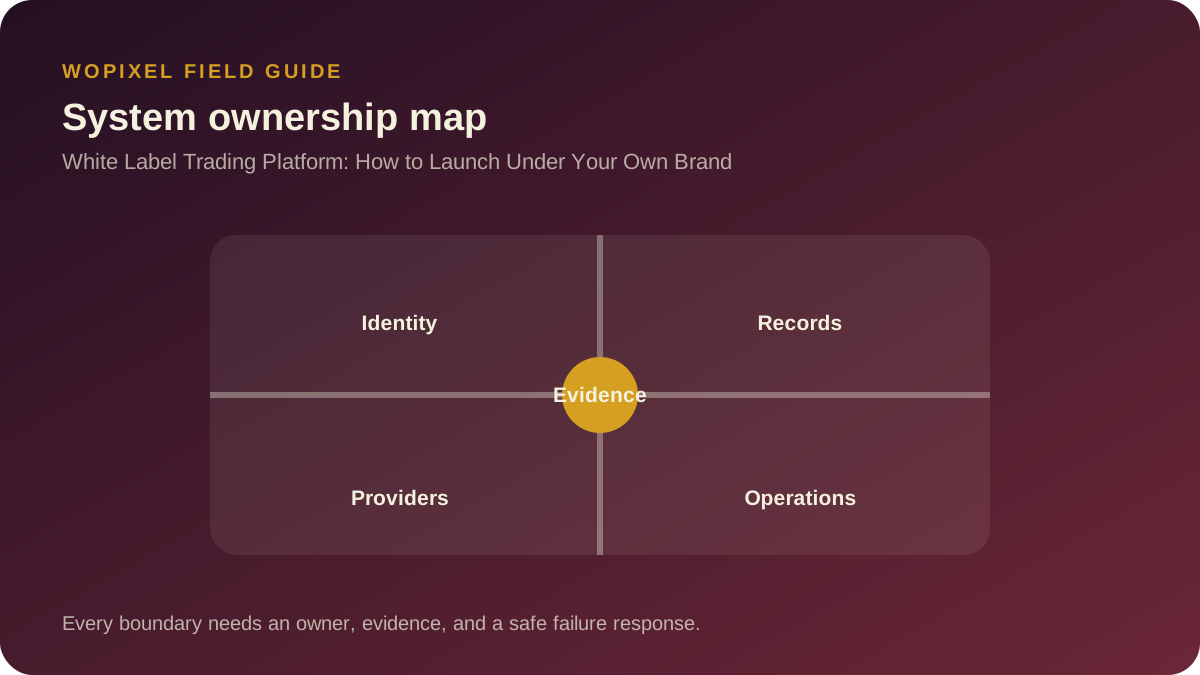
- Branding: logo, colors, domain, email identity, public pages, and language.
- Product policy: assets, markets, fees, limits, onboarding rules, and support channels.
- Operations: wallet management, reconciliation, monitoring, incident response, and staff roles.
- Commercial ownership: customer relationship, pricing, partnerships, and retention strategy.
WoTrade can be evaluated through its official product overview, then compared with the responsibilities described in the provider's contract. The public WoTrade demo helps explain the user experience, but the commercial and operational boundaries need to be confirmed directly.
The customer sees a brand; the business runs a system
A customer may judge the platform by its onboarding flow, order screen, notifications, and withdrawal experience. Behind those screens are decisions about identity verification, account limits, suspicious activity, failed deposits, support escalation, and the accuracy of balances. A white label provider should show how these functions are administered and audited.
Before launch, create a service map that names the owner of every customer-impacting event. Who approves a withdrawal? Who pauses a market? Who responds when a blockchain confirmation is delayed? Who investigates a disputed trade? If the answer is "the provider" for everything, the operator may have little control. If the answer is "the client" for everything, the white label package may not reduce enough work.
Brand control must include trust control
Changing a logo is easy. Building trust takes consistent detail. Branded emails should use the same domain as the product, help pages should explain fees and limits in plain language, and status messages should tell customers what is happening during a delay. The platform should make it possible to create a coherent experience across onboarding, trading, security alerts, and support.
- Define the first customer segment and the markets it is allowed to access.
- Write the fee, limit, verification, and withdrawal policies before configuring the interface.
- Assign internal owners for support, finance, compliance, security, and vendor management.
- Run a closed pilot with test deposits, withdrawals, orders, notifications, and support tickets.
- Measure failed flows and fix the confusing ones before buying traffic.
Hosted white label or source code?
Hosted white label software usually offers a faster start. The provider controls more of the infrastructure and can handle routine releases, while the operator accepts limits on deep customisation and portability. With source code, the operator can change the product and control deployment, but it needs engineers, security processes, monitoring, and a realistic maintenance budget.
WoTrade's SaaS offering and source-code offering illustrate why this is a strategic decision rather than a simple pricing comparison. Choose the model that matches the team's ability to operate the platform after the launch announcement is over.
Questions to ask the provider
- Is the deployment dedicated, shared, or configurable between the two?
- Who owns the customer data and how can it be exported?
- Which integrations are included, and who pays for third-party services?
- How are releases tested, communicated, and rolled back?
- What happens to the brand and the data if the agreement ends?
A white label trading platform works best when it gives a new operator a credible foundation without hiding the responsibilities that make the service safe and dependable. Make those responsibilities explicit, test the complete customer journey, and the platform becomes a launch asset rather than a reskinned demo.
A practical implementation workbook for White Label Trading Platform: How to Launch Under Your Own Brand
The original guide explains the core idea. This expanded workbook turns launch strategy, acquisition, and sustainable commercial growth into a decision that founders, agencies, marketers, and product owners can inspect, budget, test, and operate. That added depth matters because a feature can look complete in a demonstration while its failure states, ownership, and total cost remain undefined. Treat every claim as a requirement that needs evidence.
Start with a one-page brief: the customer, problem, allowed jurisdictions, day-one journey, data and money movement, internal owner, external providers, support coverage, success metric, and explicit exclusions. Keep “available eventually” separate from “accepted for launch.” This prevents optional plugins and attractive comparisons from quietly becoming dependencies.
Translate the topic into testable scope
For launch strategy, acquisition, and sustainable commercial growth, write scenarios in plain language before discussing screens. Name the actor, starting state, requested action, validation, financial effect, audit evidence, notification, administrative visibility, and recovery path. Include rejected, pending, duplicated, delayed, cancelled, partially completed, and reversed outcomes. These states reveal more about platform maturity than a long feature list.
The day-one scope should fit inside one release that the team can support. Put integrations behind explicit contracts for authentication, timeouts, retries, idempotency, versioning, sandbox differences, and exit. If a provider becomes unavailable, the platform should fail predictably, preserve evidence, and give operators a useful queue rather than leaving customers with an unexplained balance or spinner.
Architecture and ownership questions
- System boundary: identify the Laravel application, database, cache, queues, scheduler, object storage, frontend build, administration, and every third-party service.
- Source boundary: list delivered repositories, lock files, migrations, private dependencies, licenses, build commands, tests, and artifacts that remain vendor-controlled.
- Data boundary: classify identity, authentication, financial, behavioral, support, and operational data; record retention, access, export, deletion, and backup rules.
- Operational boundary: assign monitoring, reconciliation, provider escalation, security patches, framework upgrades, customer communication, and recovery testing.
Ask the seller to demonstrate a clean installation and a failure recovery, not only the happy path. For source code, the buyer should be able to run the documented dependency installation, asset build, database migration, queue worker, and scheduler. For hosted software, the written proposal should identify environment, backup, monitoring, support, data export, change-request, and termination boundaries.
Risks that deserve an explicit control
- traffic that does not match the product offer
- promises the delivery cannot support
- weak attribution between content and qualified inquiries
- expanding features before retaining the first cohort
- affiliate or revenue rules without transparent evidence
Record each risk with prevention, detection, response, owner, and evidence. “The platform is secure” is not a control. Examples of evidence include an authorization test, immutable audit event, reconciliation report, alert exercise, restored backup, dependency report, or signed acceptance result. Match assurance effort to the consequences of error.
Budget beyond the headline price
The current WoTrade Core listing shows a $490 source-code price, while the hosted WoTrade listing starts at $119 monthly. Individual module pricing is separate and several focused modules are listed below $200. Confirm current pages and written scope because pricing, inclusions, discounts, and support can change.
Model acquisition, implementation, infrastructure, external providers, people, security, compliance, maintenance, contingency, and exit. A source license may fit below a budget threshold while the production business does not. A hosted subscription can reduce deployment work while still requiring provider fees, internal operations, product decisions, and jurisdiction-specific advice. Honest pages explain both facts.
| Decision | Hosted route | Source-code route |
|---|---|---|
| Time to private validation | Usually fewer deployment tasks | Depends on build reproduction and technical acceptance |
| Customization control | Within available configuration and agreed work | Broader, subject to license and internal capacity |
| Maintenance ownership | Shared according to hosted terms | Primarily buyer responsibility after delivery |
| Exit work | Data export and transition planning | Environment, providers, updates, and operations remain with buyer |
A staged decision and delivery sequence
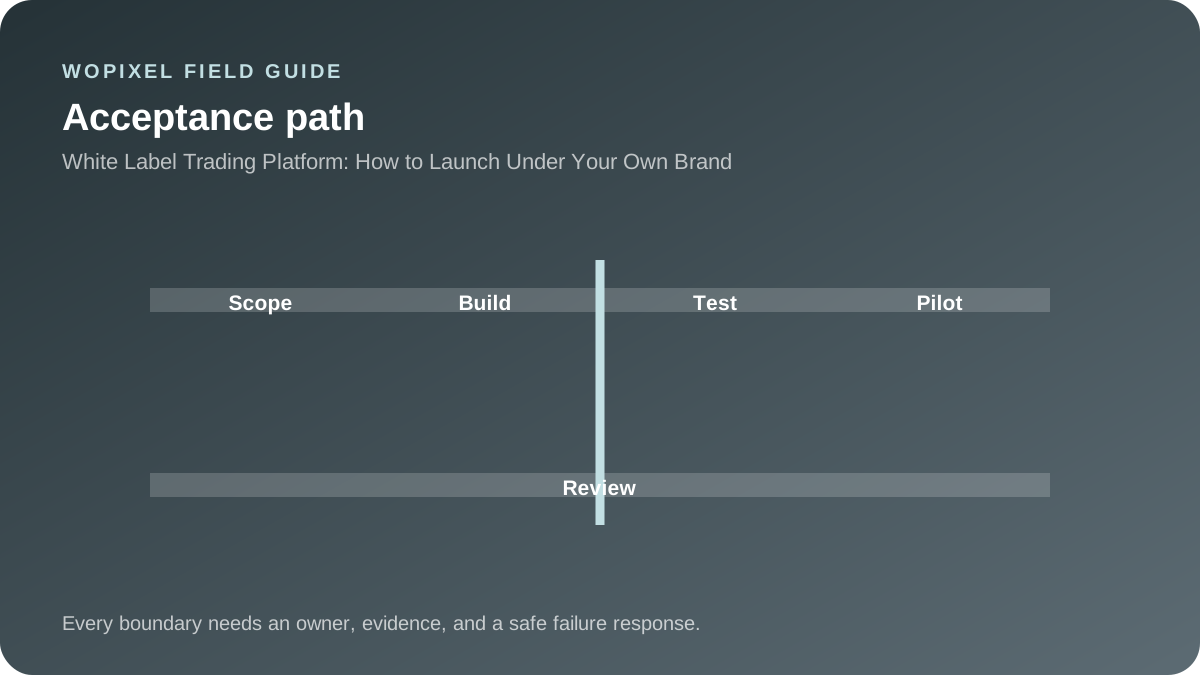
- Choose one buyer problem and original positioning.
- Publish evidence-rich content around a specific decision.
- Connect the page to the most relevant hosted or source offer.
- Measure qualified actions and objections.
- Improve the product and content from recorded evidence.
Place a pass/fail gate after each step. A failed gate does not automatically mean the product is unsuitable; it means the gap needs an owner, price, deadline, retest, and impact on launch scope. This produces a useful backlog and prevents verbal assumptions from becoming expensive surprises.
Security, accounting, and operator acceptance
Use the OWASP API Security project to structure API review, the NIST Digital Identity Guidelines for authentication assurance, and the NIST Cybersecurity Framework for governance and incident readiness. These do not replace a product-specific threat model or independent professional review.
Test account takeover defenses, permission escalation, replay, duplicate callbacks, object-level authorization, secret storage, session revocation, rate limiting, audit completeness, and safe error handling. For financial state, verify precision, fees, reservations, concurrency, reversals, reconciliation, and immutable evidence. Operators must be able to identify exceptions and act without direct database edits.
Measure whether the article’s recommendation worked
- qualified organic landing sessions
- product-page click-through from guides
- demo or purchase intent by content cluster
- activation, retention, and support guardrails
Pair outcome metrics with guardrails. Faster activation is not a win if support contacts, failed transactions, reconciliation exceptions, or security exposure rise. Review measures by cohort and release so a product change can be connected to evidence rather than opinion.
Procurement and demo checklist
- Receive the exact license, delivery inventory, support boundary, update policy, and payment terms before relying on a marketing label.
- Run the build in a clean environment and record versions, commands, warnings, private dependencies, and required manual steps.
- Demonstrate the complete primary journey plus duplicate, rejected, delayed, and recovery cases.
- Review roles and privileged actions with a least-privilege matrix and a sample audit investigation.
- Reconcile a controlled test set from user action through ledger evidence, provider evidence, fees, and reporting.
- Write the first 90 days of maintenance, monitoring, backup, incident, and provider ownership.
Frequently asked implementation questions
Does more source code mean a more complete product?
No. Completeness is demonstrated by reproducible builds, coherent architecture, working state transitions, tests, documentation, licensing, and operability. File volume alone is not meaningful evidence.
Should every available WoTrade module launch at once?
No. Select the modules required for the first customer promise. Every module adds permissions, data, edge cases, support load, monitoring, and upgrade work that must be accepted.
Can a low software budget validate the idea?
Yes, if the experiment is narrow and the claim is precise. A $490 core license or a focused sub-$200 module can support technical validation; neither number represents the full cost of operating a public financial platform.
What makes content about this topic trustworthy?
It distinguishes price categories, states limitations, links to current product pages and primary references, avoids copying brands, gives acceptance criteria, and helps the reader decide when the product is not a fit.
Conclusion: make the next decision reversible
White Label Trading Platform: How to Launch Under Your Own Brand becomes useful when it reduces uncertainty rather than increasing feature excitement. Define the smallest responsible scope, verify it with evidence, price the whole operating model, and keep ownership visible. Then use results from a private pilot to decide whether the next investment is a module, integration, security control, operational hire, or a wider launch.
Deep-dive 1: customer protection for White Label Trading Platform: How to Launch Under Your Own Brand
A useful review of launch strategy, acquisition, and sustainable commercial growth should describe what happens before, during, and after the primary action. Before it, validate identity, permissions, configuration, provider availability, limits, balance or entitlement, and replay protection. During it, create a durable identifier, preserve state transitions, protect concurrent updates, and produce structured operational events. After it, reconcile the result, notify the right actor, expose a safe history, and make exceptions visible to an accountable operator.
Run a tabletop exercise in which the external response is late, duplicated, malformed, or contradictory. The team should be able to state whether the request is safe to retry, how the customer sees the status, where evidence is stored, what alert fires, and who decides the recovery action. If the answer requires an engineer to edit production data directly, the workflow is not yet operationally complete.
Finally, connect the requirement to a release artifact: an automated test, written procedure, dashboard, alert, reconciliation sample, permission matrix, restored backup, or signed acceptance record. Record the version and environment. Evidence makes future upgrades safer because the team can rerun the same check after a framework, provider, plugin, or configuration change.
Deep-dive 2: change control for White Label Trading Platform: How to Launch Under Your Own Brand
A useful review of launch strategy, acquisition, and sustainable commercial growth should describe what happens before, during, and after the primary action. Before it, validate identity, permissions, configuration, provider availability, limits, balance or entitlement, and replay protection. During it, create a durable identifier, preserve state transitions, protect concurrent updates, and produce structured operational events. After it, reconcile the result, notify the right actor, expose a safe history, and make exceptions visible to an accountable operator.
Run a tabletop exercise in which the external response is late, duplicated, malformed, or contradictory. The team should be able to state whether the request is safe to retry, how the customer sees the status, where evidence is stored, what alert fires, and who decides the recovery action. If the answer requires an engineer to edit production data directly, the workflow is not yet operationally complete.
Finally, connect the requirement to a release artifact: an automated test, written procedure, dashboard, alert, reconciliation sample, permission matrix, restored backup, or signed acceptance record. Record the version and environment. Evidence makes future upgrades safer because the team can rerun the same check after a framework, provider, plugin, or configuration change.